
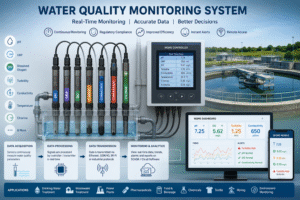
A modern online water quality monitoring setup with pH, DO, and turbidity sensors.
Introduction
A Water Quality Monitoring System (WQMS) is an integrated solution that continuously measures and records critical water quality parameters in real time. It combines sensors, analyzers, controllers, communication devices, and software to provide accurate information about water conditions. Industries, municipalities, utilities, and environmental agencies use these systems to ensure regulatory compliance, improve treatment efficiency, protect equipment, and maintain public health.
Unlike traditional laboratory testing, online monitoring provides continuous measurements, allowing operators to detect changes immediately and take corrective action before problems become critical.
How Does a Water Quality Monitoring System Work?

Sensor probes are the front line of any WQMS — measuring pH, ORP, conductivity, and more.
A typical WQMS consists of:
- Sensors and analyzers for pH, ORP, conductivity, dissolved oxygen (DO), turbidity, temperature, BOD, COD, TOC, chlorine, ammonia, and other parameters.
- Controller or transmitter to process sensor signals.
- Data logger or PLC for storage and automation.
- SCADA or cloud software for dashboards, trends, alarms, and reports.
- Communication via Ethernet, Modbus, GSM/4G, Wi-Fi, or industrial protocols.
Water passes through the measurement chamber where sensors continuously analyze the sample. The measured values are transmitted to the controller and displayed locally or remotely. If a parameter exceeds a predefined limit, alarms are generated and operators can respond immediately.

SCADA dashboards give operators live trends, alarms, and historical reports in one place.
Benefits
- ✅ Continuous 24/7 monitoring
- ✅ Improved regulatory compliance
- ✅ Reduced laboratory testing costs
- ✅ Early detection of pollution events
- ✅ Better treatment efficiency
- ✅ Historical reports and analytics
- ✅ Remote monitoring and predictive maintenance
Industries
Water quality monitoring systems are widely used across many sectors:
- Drinking Water Plants
- Wastewater Treatment
- Pharmaceuticals
- Food & Beverage
- Power Plants
- Chemical Industries
- Textile Manufacturing
- Mining
- Environmental Monitoring
Conclusion
A modern Water Quality Monitoring System enables organizations to monitor water quality continuously, reduce operational risks, optimize treatment processes, and comply with environmental regulations. Investing in a reliable online monitoring solution helps improve efficiency while ensuring safe and sustainable water management.
Need help choosing the right water quality monitoring system for your facility?